
This Huge Company Let Customers Roast Them… Then They Printed the Insults
MM
This Huge Company Let Customers Roast Them… Then They Printed the Insults
Picture this: you’re a billion-dollar brand and the whole internet is dunking on you like it’s a sport.
Not “constructive feedback.” Public execution.
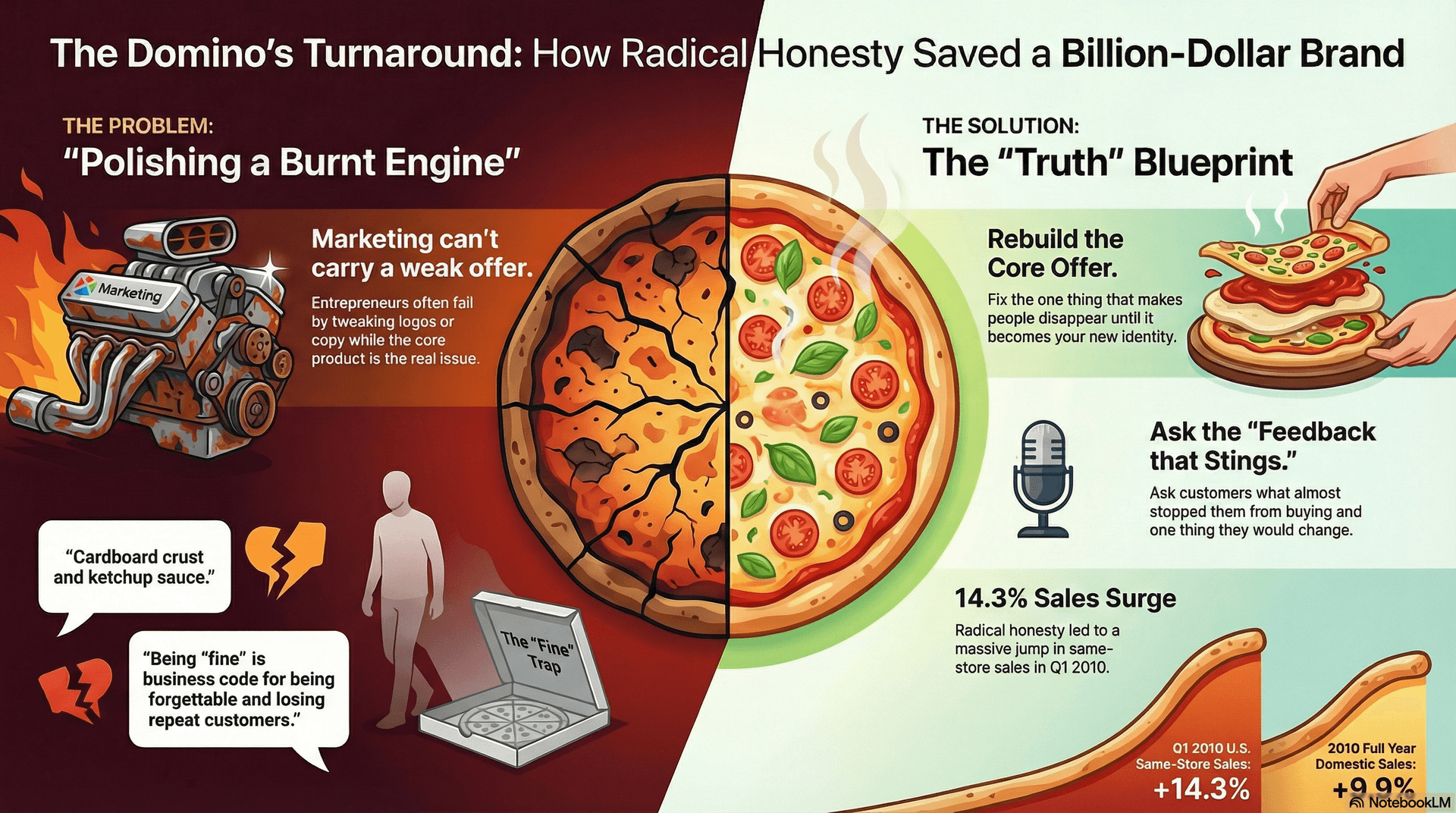
“Cardboard crust.” “Ketchup sauce.” People weren’t reviewing Domino’s— they were warning their friends. And Domino’s did what most businesses never have the guts to do:
They hit “play” on the insults. They put real customer quotes in their own ads. On purpose. That’s not marketing. That’s a controlled detonation.
Because Domino’s knew the truth that’s hard to swallow when you’re stressed, exhausted, and trying to “make it work”:
If your product (or service) is the problem, no amount of ads will save you.
Most entrepreneurs don’t fail because they’re lazy. They fail because they’re stuck polishing the surface while the engine is on fire.
They change the logo. They tweak the copy. They post more. They buy another course.
They avoid the brutal question: Why aren’t people coming back?
Domino’s stopped dodging. They looked straight at the mess and said, “You’re right.” Then they did the unsexy work.
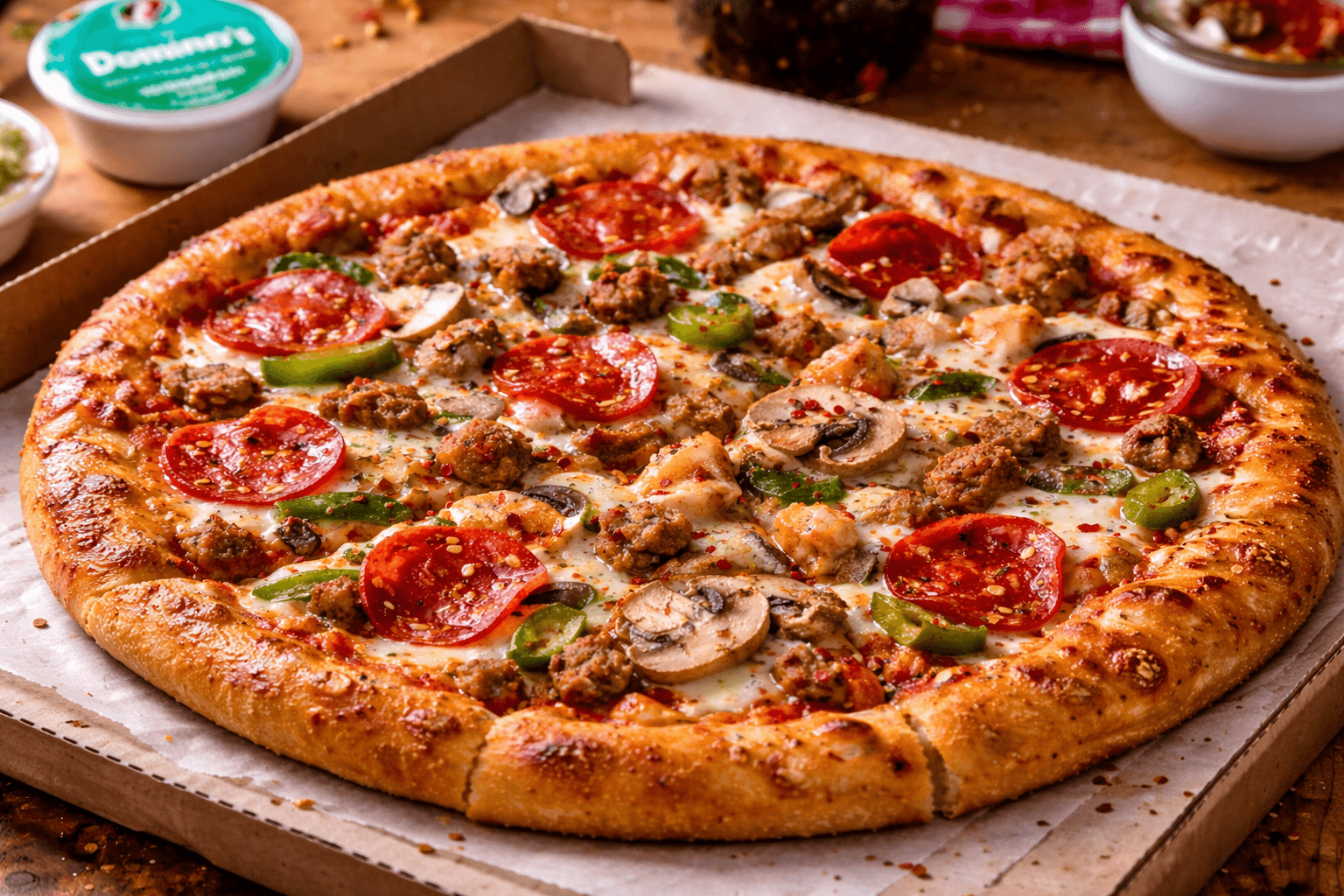
They rebuilt the pizza from the crust up—new garlic-seasoned crust, upgraded sauce, better cheese—because the core offer was the issue, not the promotion.
And they didn’t whisper it.
They made a loud promise that shifted the risk off the customer and onto themselves.
Here’s what happened next.
In early 2010, U.S. same-store sales jumped 14.3% in Q1. For the year, domestic sales grew 9.9%.
Not because they found a secret ad platform.
Not because they “optimized” their way out.
Because they fixed the thing that was quietly killing them: the reason customers didn’t return.
And this is where you should pay attention—because your business isn’t Domino’s, but your problem might rhyme.
If you’re not getting repeat customers, referrals, renewals, upgrades… you don’t have a marketing problem.
You have a core problem.
Marketing can’t carry a weak offer forever. It can only hide it for a little while.
So, if you’re grinding and still stuck, don’t automatically assume you need more traffic. Assume you need more truth.
Start where most people refuse to start: feedback that stings.
Not the “Hey, loved it!” comments.
The friction. The hesitation.
The reason someone bought once… and then disappeared.
Send three questions to customers and ex-customers:
Why did you choose us the first time?
What almost stopped you from buying?
If you could change ONE thing about us, what would it be?
Then shut up and read the answers like a professional.
No defending yourself. No explaining what they “really meant.”
If they say your version of “crust” is cardboard—your onboarding, your delivery time, your communication, your quality, your consistency—believe them.
Because their perception is the only reality that matters at checkout.
Now here’s the part where people screw it up. They try to fix everything at once.
They patch ten leaks and wonder why the boat still sinks.
Don’t do that.
Pick the ONE thing that would make people come back… and fix it so hard it becomes your new identity.
Maybe your leads wait too long for a reply and feel ignored.
Maybe your service is solid, but the process feels chaotic.
Maybe the result is good, but the experience is stressful.
Maybe you’re “fine,” which is business code for “forgettable.”
Choose one. Make it undeniable.
Then tell the story—clean and simple:
We listened. We changed. Here’s exactly what’s different now.
And don’t just say you improved. Prove it by carrying the risk.
Guarantee the outcome.
Fix mistakes fast.
Make it safe for people to try the new version of you without feeling stupid if it doesn’t work out.
That’s the Domino’s lesson.
Not “run better ads.”
Not “post more content.”
Stop hiding from the real problem.
Face it. Fix it.
Then let marketing amplify something that actually deserves attention. Because the fastest way to get your business moving isn’t another tactic.
It’s the moment you finally ask the question that scares you:
What do I need to fix so customers can’t help but come back?
I've walked dozens of businesses through this. It's very telling for those who are willing to face up to it and make the necessary changes.